Monday, August 31, 2009

Absolutely. Maybe existentialism should be the next topic we talk about. I didn't mention it directly just because I was trying to be succinct, but you are right.

Cory

Sorry, Chuck, I tried to edit the format of the email you sent but it didn't work.
Cory,

This is great. I enjoyed reading it and will talk with Kevin today
sometime to see when we can set up our iThink group on the new
software at CBC.

I'm wondering if "Existentialism" doesn't fit into your discussion
somewhere. I'm not sure where that would be, but it seems that when
man found he could not legislate morality without God, there was a
movement that said nothing is of higher value than anything else we
just all exist = existentialism. If you see an old woman on the
street corner, stopping to help her cross the street or running her
over has the same moral value. Didn't this lead to nihilism and I
think Neitzschke had something to do with this.

It just seems that a pessimism about standards of living and purpose,
meaning and significance were lost to many souls and that opened the
door to the "God is dead" movement.

Does existentialism fit in the movement from modernism to
post-modernism?

Chuck

Postmodernism

Ok, this discussion of the transition from modernism to postmodernism has taken a while. In the last few hundred years changes in ideas have been fast and furious, so there is a lot to talk about. Another reason is that the transition here is a little difficult to follow. One way to look at it is that postmodernism isn't really a distinct way of thought, it is just the natural outcome of modernism. I think there is a lot of truth in that.

More about that in a bit, but first, let's talk a little about what 'postmodernism' is. Do these characteristics sound familiar?

1. No single world view captures reality. There is no master story or meta-narrative that underlies humanity.

2. Reason is to be distrusted because there is no way of knowing which individual's reason is reliable.

3. There is no such thing as objectivity.

4. There is no 'truth' to appeal to for understanding history and culture.

5. There are no moral absolutes.

6. The West, with it's colonial heritage, deserves ridicule.

7. Texts, whether religious or philosophical or literary or legal, do not have intrinsic meaning.

8. Ideas are cultural creations.

9. Everything is relative.

10. We need to be deeply suspicious of all ideas, given the way ideas are used as tools to oppress and confuse people.


Looks a lot like the culture we live in now, doesn't it? Well, this isn't the first time this has happened. This is the same basic description of the presocratic world. Remember, it is hard to talk about 'what the Greeks thought' because there were Greeks who thought just about everything. Before Socrates there was Protagoras, who was the first to say, "Man is the measure of all things." It was also a very relativistic culture. The sophists (from whom we get the words sophistry and sophisticated) were intellectual guns for hire, who really believed in nothing, but would take any side in a debate. The more skilled at it they were the more money they made. But it was all just a game, a way to coerce as many people as possible. It is no wonder reason was distrusted and truth was viewed as relative.

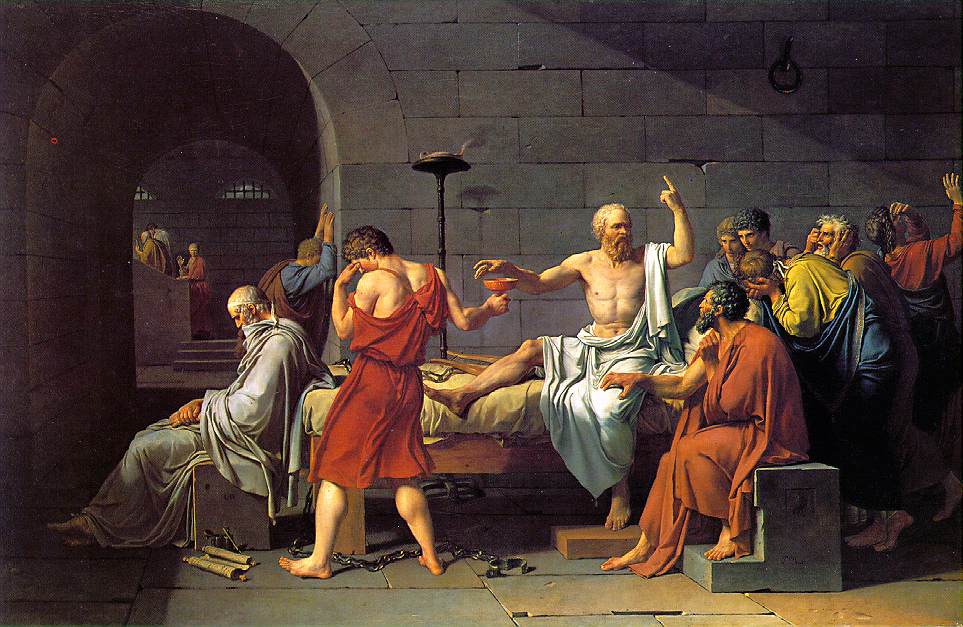
Then came Socrates. Socrates said, "God is the measure of all things," and stood up for truth. His 'God' was an unknown god to him (see Acts 17), but he made a remarkable stand for a pagan.

Socrates' ideas and those of other Greeks contributed significantly to Judeo-Christian thought. Then the modern thought came along seeking to have "Good without God." Human reason alone was supposed to supply us with all we needed to govern ourselves. The problem there, as we've discussed already, was the 'good' we were trying to demonstrate through reason was largely imported in from the Judeo-Christian ethic. Nietzsche and others showed there was no foundation for right and wrong if the Judeo-Christian God was dead. We tried to be our own gods.

The fruits of that endeavor were clear enough. WWI and WWII, and numerous other atrocities. In short, the bloodiest century in history. Next time someone tries to tell you that all wars are the result of religion, and religion is therefore bad, remind them of the legacy of humanism.

It was obvious that the goal of "Good without God" was untenable. This brings us back to the syllogisms we talked about:

If God does not exist, then morality cannot be justified
But morality can be justified
Therefore, God must exist
(modus tollens)

or

If God does not exist, then morality cannot be justified
God does not exist
Therefore, morality cannot be justified
(modus ponens)

Remember that it was the end of modernism when thinkers started to realize the truth of the first premise. What if they had then gone back to examine if there really could be "Good without God"? Finding the answer to be, no, why didn't they go back and embrace Christianity? Why didn't they realize they were wrong to dismiss Him and run back to Him? If only they had. A few did of course, but the overwhelming response was just to look into the abyss and try to be our own gods.

But what happened is just what we should expect, isn't it? Mankind couldn't resist the temptation to be his own god.

This brings to mind some Chesterton said somewhere (paraphrased): "The doctrine of original sin is the only doctrine of the church that can be empirically proved." The truth of original sin is staring everyone in the face, but no one wants to see it.

While on the subject, here's another quote from Chesterton:
“Once abolish the God, and the government becomes the God.” - Christendom in Dublin, 1933

Sunday, August 16, 2009

Over on the right hand column of the blog I added another link to an article by Doug Groothius. This article is on the Christian Research Institute's website, equip.org. Groothius is (or at least was) a prof at Denver Seminary, and I heard him speak at our Sunday School class once when I was in med school. This article on relativism is short, but speaks to some of the things we've been talking about.

The Christian Research Institute is the home of Hand Hanegraaff, The Bible Answer Man. Another good website to check out is Stand to Reason, www.str.org.

Saturday, August 15, 2009

Here's some more about the 'existence' issue Chuck brought up. This link should get you to a forum that discusses some of the points
http://memoriapress.com/forum/showthread.php?t=27&highlight=existence

But this paragraph make the main point:

"The reason for this would involve a more complicated discussion of set theory’s acceptance of the possibility of an empty set, but the fundamental reason goes back to the fact that, in traditional logic, predicates refer to concepts (where the nature or essence of a thing is known), whereas in modern logic predicates are sets that are defined by their members. All of which is just another way of saying that traditional logic assumes that words have meaning apart from the actual existence of their objects and modern logic does not."

This ties into several other issues. The modern idea that "words don't really have meaning" is where the idea comes from that the constitution, or the Bible for that matter, doesn't have any meaning apart from the meaning the reader wants to put into it. So things can mean whatever you want them to mean. But more to the point is that the traditional approach assumes that essence precedes existence, whereas the modern approach assumes that existence precedes essence.


This all incredibly brief, but it seems to me the "existence" contention assumes a modern instead of a Judeo-Christian perspective. We know the Bible assumes that our essence precedes our essence. God had us in His mind, and what we were supposed to be, before we were born. God had right and wrong, and meaning and purpose, all figured out before people came along to decide those things.


That seems a long way from the Ontological Argument, but it's all part of the discussion of whether 'existence' is really an attribute.


There have been other rebuttals of the Ontological Argument. One is that the argument is really a tautology. That is to say it is just a redundant statement with the conclusion just restating the premise. But that doesn't refute anything, because tautologies are valid. If the premises are true a tautology is sound. And some people argue that all deductive arguments are tautologies because the conclusion is really contained in the premises. But that is a little convoluted, because it is like complaining that a conclusion really does follow from the premises. The thing about tautologies is that sometimes they are useful to unpack or restate something in a way that shed's more light on the subject, and I think the Ontological Argument clearly does.

Wednesday, August 12, 2009

Thanks Chuck,

Good question. My short response is that if 'existence' is not an attribute, or quality, or property, then there is no qualitative
difference between a child's imaginary friends and real friends.

Cory
Cory,
 
One struggle I've heard with the ontological argument is that idea of "existence" itself. Is that really an attribute? I'm not sure I understand all this, but it sure was fun to read your blog. I enjoyed it a lot. If I get a chance I'm gonna look into the ontological argument when I get a chance and see what else I can find.
 
Chuck